

Introduction
The first time Sarah noticed 127.0.0.1:62893 on her computer screen, she panicked. It looked like a strange internet address, and she worried that someone had hacked into her system. After spending hours searching online, she discovered something surprising—it wasn’t a hacker at all. It was simply her own computer talking to itself.
Many people experience the same confusion. Whether you’re installing software, testing a web application, or troubleshooting a development tool, seeing 127.0.0.1:62893 can be both mysterious and intimidating. The numbers seem technical, but the concept is much simpler than it appears.
Understanding this address helps remove unnecessary fear and gives you a clearer picture of how computers work behind the scenes. Once you understand localhost and ports, you’ll recognize that this mysterious-looking address is often a normal and useful part of everyday computing.
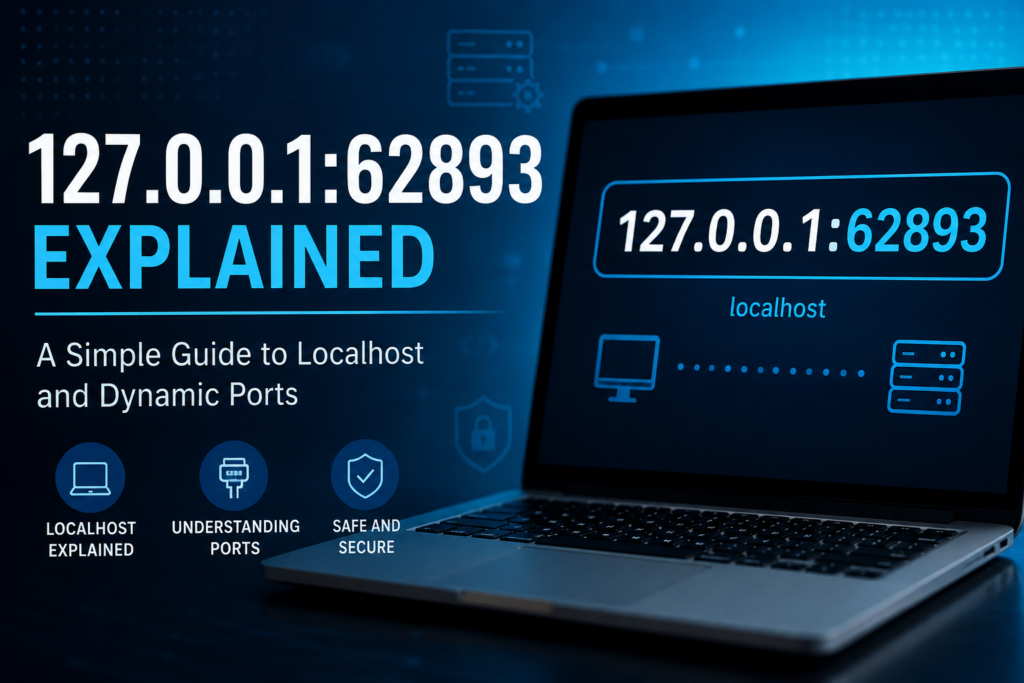
What Does 127.0.0.1:62893 Actually Mean?
Imagine your home has an intercom system that lets family members communicate without making a phone call outside the house. That’s similar to how 127.0.0.1 works. It is known as the localhost or loopback address, meaning your computer sends information back to itself rather than across the internet.
The second part, 62893, represents a port number. Think of ports as apartment numbers inside a building. While the building is your computer, each apartment—or port—allows a different application to communicate independently. Dynamic ports like 62893 are usually assigned temporarily whenever an application needs a private communication channel.
For example, if you’re running a local website, using database software, or testing an application, your operating system may automatically assign a random port such as 62893. Once the application closes, the port is typically released for future use. That’s why you may never see the same port number twice.
Understanding this simple relationship makes the entire address much less intimidating.
Why You Might See 127.0.0.1:62893 on Your Computer
Many people assume every unfamiliar address is connected to the internet, but that’s rarely the case with localhost. Modern software often creates temporary local servers to perform tasks efficiently without exposing data to external networks.
For instance, a web developer may launch a testing server before publishing a website. Instead of using a public domain, the browser opens 127.0.0.1:62893 so the developer can safely test new features. The website works exactly as it would online, but only on that specific computer.
Even non-developers encounter localhost. Applications like code editors, database managers, browser debugging tools, game launchers, AI software, and desktop utilities frequently use temporary local ports for communication between different parts of the same program.
A helpful analogy is rehearsing a stage play before opening night. Actors practice privately before performing in front of an audience. Likewise, applications often “rehearse” on localhost before interacting with the outside world. The process remains private, secure, and invisible to everyone except the local computer.
Is 127.0.0.1:62893 Safe or Dangerous?
The short answer is that 127.0.0.1:62893 is usually perfectly safe.
Because 127.0.0.1 always points back to your own computer, outside users cannot directly access services running only on localhost. This built-in isolation is one reason developers rely on localhost when building websites, testing APIs, or experimenting with new software.
However, context always matters. If you intentionally installed trusted software and suddenly see 127.0.0.1:62893, it’s likely functioning exactly as designed. On the other hand, if unknown software unexpectedly starts local servers or consumes unusual system resources, it’s worth investigating further.
Good cybersecurity habits still apply. Keep your operating system updated, download software only from reputable sources, and maintain reliable antivirus protection. These practices help ensure that local services remain trustworthy.
Think of localhost like a private meeting room inside your office. The room itself isn’t dangerous. The important question is simply who is using it and for what purpose.
Common Uses of Localhost Ports in Everyday Computing
Although localhost is closely associated with programmers, it quietly powers many everyday applications. Developers use it for website testing, API development, database management, and debugging complex software before deployment.
Creative professionals also benefit from localhost without realizing it. Video editing applications, machine learning tools, desktop dashboards, and synchronization software often launch temporary local web interfaces. These interfaces provide fast communication between software components without relying on an internet connection.
Students learning programming often begin by hosting their first website on 127.0.0.1 before purchasing a domain name. This approach encourages experimentation because mistakes stay safely confined to one computer.
The temporary port number, such as 62893, acts like a reserved workspace. Once the project finishes, the operating system cleans up the connection, making room for future applications. This dynamic system allows thousands of programs to coexist efficiently without interfering with one another.
The more you understand localhost, the more you’ll notice how many modern technologies quietly depend on it every single day.
Frequently Asked Questions
Q1. What is 127.0.0.1:62893?
It is a localhost address combined with a temporary port number. The address refers to your own computer rather than another device on the internet. Applications use it for local communication during development or normal operation.
Q2. Is 127.0.0.1:62893 connected to the internet?
No. The address stays entirely within your own computer. Traffic sent to 127.0.0.1 never leaves your device, making it ideal for secure local testing and communication.
Q3. Why does the port number keep changing?
Operating systems automatically assign available temporary ports whenever applications need them. A different application or even the same application at a different time may receive another port number, such as 52114 or 63421 instead of 62893.
Q4. Can hackers access my computer through 127.0.0.1:62893?
Normally, no. Services listening only on localhost cannot be reached directly from external devices. The main security concern would come from malicious software already running on your own computer rather than the localhost address itself.
Q5. Can I safely close a localhost application?
Usually, yes. Closing the associated application typically shuts down the localhost service and releases the port automatically. If you’re unsure, save your work before exiting the program.
Q6. How can I identify which program is using port 62893?
You can use operating system tools such as netstat, Resource Monitor, Task Manager, or lsof (on Linux and macOS) to identify the application associated with a specific port. These utilities help troubleshoot network-related issues and verify which software is active.
Conclusion
The mysterious address 127.0.0.1:62893 often looks far more complicated than it truly is. Instead of representing an unknown internet destination, it usually reflects your computer communicating with itself through a temporary port assigned to a trusted application. This simple mechanism powers website development, software testing, debugging, desktop applications, and countless background processes that most users never notice.
Learning how localhost works transforms confusion into confidence. Rather than fearing unfamiliar numbers, you begin recognizing them as part of the technology that keeps modern software running smoothly. Understanding these small technical details also builds stronger digital literacy, making it easier to troubleshoot problems and recognize what is normal versus what deserves attention.
Technology becomes less intimidating when we understand the stories behind the numbers. Sometimes, what looks like a complicated network address is simply your computer having a quiet conversation with itself—and that’s exactly how it’s supposed to work.