

Introduction
A curious twelve-year-old once asked her science teacher why so many difficult scientific words sounded mysterious. While flipping through a biology textbook, she pointed at the word kinetic and smiled, saying, “It sounds like something from a superhero movie.” That simple moment turned into an exciting classroom discussion where students discovered that scientific words aren’t just complicated terms—they’re keys that unlock how our world works.
Many science words beginning with the letter K have fascinating stories behind them. Some describe the movement of energy, while others explain microscopic organisms, chemistry, astronomy, and even genetics. Learning these words isn’t only useful for students preparing for exams; it also helps anyone appreciate the incredible language scientists use to describe nature. Let’s explore some of the most important and interesting science words that begin with K and see why they matter in everyday life.
The Power of “K” in Science
At first glance, the letter K may seem uncommon in English, but it holds a surprisingly important place in science. Words like kinetic, kelvin, keratin, and kilogram appear regularly in classrooms, laboratories, and scientific research around the world.
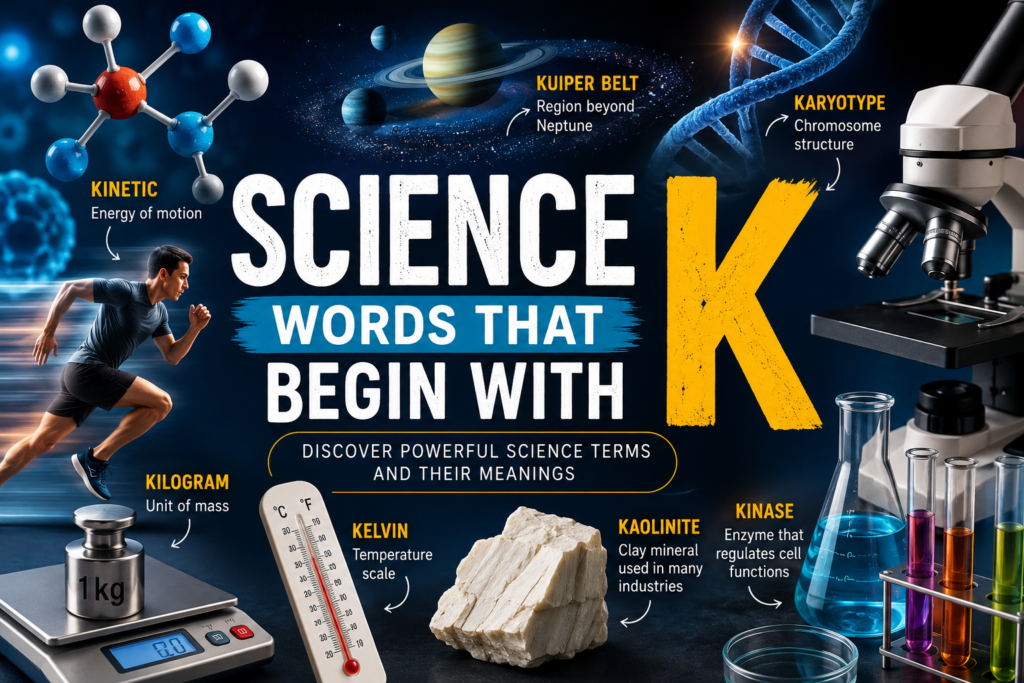
Imagine riding your bicycle down a hill. As you gain speed, you’re experiencing kinetic energy, the energy of motion. Without realizing it, you’re applying one of the most fundamental ideas in physics. Similarly, when scientists measure temperature in advanced experiments, they often use the Kelvin scale instead of Celsius because it starts from absolute zero, the coldest possible temperature.
Even something as familiar as your hair and nails introduces another scientific K-word: keratin, the tough protein that gives them strength. These examples show that science isn’t hidden away inside laboratories. It’s woven into our daily lives, and understanding these words helps us see ordinary experiences in a completely new way.
Exploring Biology and Chemistry with K
Biology and chemistry introduce several fascinating science words beginning with K. One of the most important is karyotype, a picture of an individual’s chromosomes arranged in pairs. Doctors use karyotypes to study genetic conditions and better understand inherited traits.
Another essential word is kinase, an enzyme that helps regulate countless chemical reactions inside living cells. Although most people never hear this term outside biology class, kinases play a vital role in growth, healing, and cellular communication. Scientists studying diseases such as cancer often investigate how kinases function because they influence how cells divide.
The chemistry world offers kaolinite, a naturally occurring clay mineral used in ceramics, cosmetics, and even medicine. What appears to be ordinary white clay actually has a fascinating chemical structure that makes it useful in many industries.
Learning these scientific terms reminds us that every unfamiliar word often represents years of discovery. Behind each definition lies the work of researchers who spent countless hours trying to understand the natural world and improve our quality of life.
Physics, Astronomy, and Measurement Terms
Physics introduces several powerful science words beginning with K that explain how the universe behaves. Kilogram is one of the seven base units in the International System of Units (SI). Every object, from a tiny apple to a massive machine, can have its mass measured using kilograms.
Astronomy gives us another exciting word: Kuiper Belt. This enormous region beyond Neptune contains countless icy objects and dwarf planets. It reminds us that our solar system is much larger and more mysterious than many people imagine. Scientists continue studying the Kuiper Belt to learn about the formation of planets billions of years ago.
Another interesting physics term is kinematics, the branch of mechanics that studies motion without considering the forces causing it. Whether engineers design roller coasters or athletes improve their running techniques, kinematics helps explain movement with incredible precision.
These words demonstrate that scientific vocabulary isn’t created simply to sound impressive. Each one provides a precise way to describe complex ideas, allowing scientists worldwide to communicate with clarity and accuracy.
Why Learning Science Words Beginning with K Matters
Many students memorize scientific vocabulary only to pass exams, but these words become much more meaningful when connected to real life. Understanding terms like kinetic energy, kelvin, or keratin makes science feel less intimidating and far more practical.
Think about cooking dinner. Heat transfers from the stove to the pan, temperatures can be measured in different scales, and chemical reactions transform ingredients into delicious meals. Even while brushing your hair, you’re interacting with keratin without realizing it. These scientific concepts quietly shape everyday experiences.
Expanding your scientific vocabulary also strengthens critical thinking. Instead of simply accepting information, you begin recognizing patterns, asking deeper questions, and connecting ideas across different subjects. Children who enjoy exploring scientific language often develop greater curiosity because every new word opens another door to discovery.
Science is more than facts and formulas. It’s a language that helps us explain everything from the smallest cell to the largest galaxy. Every new word learned becomes another tool for understanding the remarkable world around us.
Frequently Asked Questions
Q1. What are some common science words that begin with K?
Some popular science words beginning with K include kinetic, kelvin, keratin, kilogram, kinase, karyotype, kaolinite, kinematics, and Kuiper Belt. These terms belong to different branches of science such as physics, biology, chemistry, and astronomy. They are frequently used in education and scientific research.
Q2. What does kinetic mean in science?
Kinetic refers to motion or movement. In physics, kinetic energy is the energy an object possesses because it is moving. The faster an object moves, the greater its kinetic energy becomes. This concept explains many everyday activities like running, cycling, or driving.
Q3. Why is Kelvin important in science?
Kelvin is the standard temperature scale used in scientific research because it begins at absolute zero, where molecular motion is at its minimum. Scientists prefer Kelvin for experiments because it avoids negative temperature values in many calculations. It is widely used in physics, chemistry, and astronomy.
Q4. What is a karyotype used for?
A karyotype is an organized image of chromosomes used to study genetic information. Doctors and genetic specialists examine karyotypes to identify chromosomal abnormalities and inherited conditions. It plays an important role in medical diagnosis and genetic counseling.
Q5. Are science words beginning with K useful for students?
Absolutely. Learning these words improves scientific vocabulary and makes textbooks easier to understand. Students become more confident when reading scientific articles or preparing for examinations. A strong vocabulary also supports better communication in science classes.
Q6. How can I remember scientific words that begin with K?
The easiest method is to connect each word with a real-life example. Associate kinetic with riding a bicycle, keratin with hair, kilogram with grocery shopping, and Kelvin with measuring temperature. These mental connections make scientific vocabulary easier to remember and understand.
Conclusion
Science words that begin with K may seem unusual at first, but they represent some of the most important ideas in physics, biology, chemistry, and astronomy. From the motion described by kinetic energy to the temperature measured in Kelvin, from the protective keratin in our bodies to the distant Kuiper Belt beyond Neptune, these words help explain the remarkable systems that surround us every day. Learning scientific vocabulary isn’t about memorizing difficult definitions—it’s about gaining new ways to observe, question, and appreciate the world. Every unfamiliar scientific term is an invitation to discover something extraordinary. The next time you encounter a science word beginning with K, don’t skip past it. Pause for a moment, explore its meaning, and you may uncover a fascinating story that changes how you see the universe around you.