

Introduction
Mark had been driving the same route to work for years, and his morning routine rarely changed. Navigation guided him through traffic while his favorite playlist kept him relaxed during the commute. Without taking his eyes off the road, he could pause a song or skip a track directly from Google Maps. It was simple, convenient, and became something he never thought twice about.
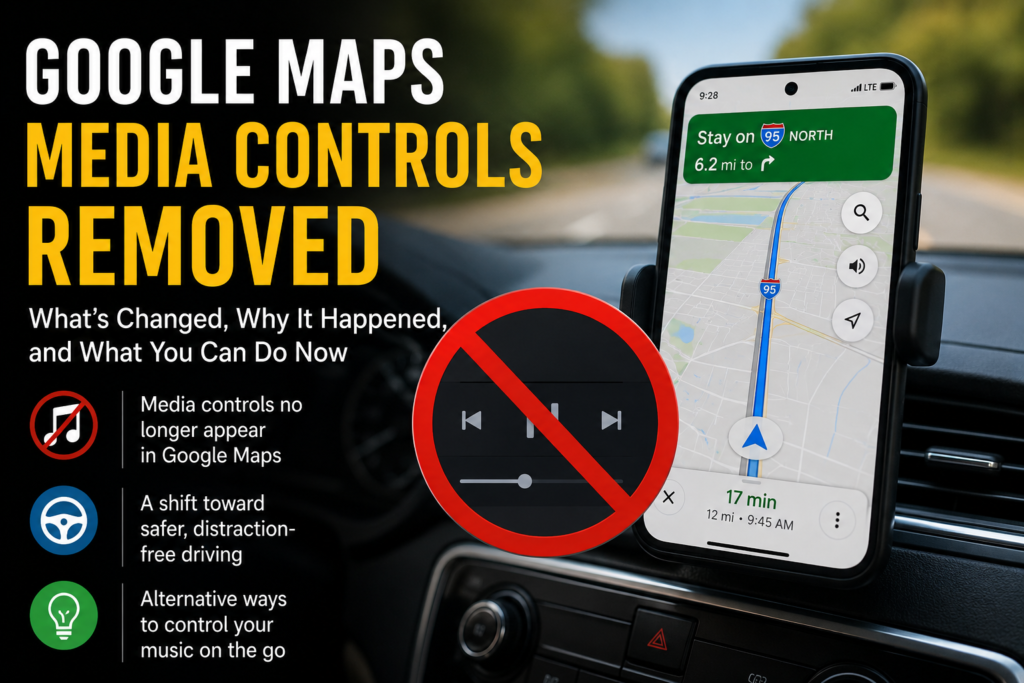
One morning, however, those familiar music controls were gone. At first, he assumed it was a temporary glitch. After checking the app and restarting his phone, he realized something had changed. Like thousands of other users, he began searching online to understand why Google Maps Media Controls Removed had suddenly become a trending topic. While the feature may seem minor at first glance, its disappearance has sparked conversations about convenience, safety, and the evolving direction of mobile applications.
Why the Media Controls Mattered
For many drivers, navigation is only one part of the journey. Music, podcasts, and audiobooks often make long commutes more enjoyable. The integrated media controls inside Google Maps allowed users to manage their entertainment without switching between multiple applications.
Imagine carrying groceries into your home. If someone suddenly removed the handles from every shopping bag, you’d still be able to carry them—but it would take more effort. That’s how many users describe losing the built-in media controls. The destination remains the same, but the experience feels less convenient.
The popularity of this feature wasn’t based on flashy design or advanced technology. Instead, it solved a practical problem by reducing unnecessary distractions while driving. Simple controls placed directly inside the navigation screen meant fewer taps, less time looking away from the road, and a smoother overall experience. Its removal has reminded users how quickly we become accustomed to thoughtful digital conveniences.
Possible Reasons Behind the Change
Whenever a familiar feature disappears, users naturally begin asking questions. Although Google regularly updates its applications, not every change is immediately explained in detail. The discussion surrounding Google Maps Media Controls Removed reflects that uncertainty.
Software development is much like renovating a busy train station. Some pathways close temporarily while improvements are made elsewhere. Occasionally, certain features disappear because they no longer align with future design goals, require technical adjustments, or create compatibility challenges with newer operating systems.
Another possibility is Google’s increasing focus on simplifying the app interface. Modern applications often remove less frequently used options to create cleaner experiences. While minimalism can improve usability for some people, others feel that useful features should remain accessible rather than disappear entirely.
Regardless of the reason, the change demonstrates how even small interface updates can generate widespread discussion when they affect millions of everyday users.
How Users Are Adapting
Technology constantly changes, and users usually adapt faster than expected. Since Google Maps Media Controls Removed became a talking point, many drivers have started exploring alternative ways to control their music safely.
Some rely on steering-wheel media buttons, while others use voice assistants to pause songs or change playlists without touching their phones. Drivers with modern infotainment systems often benefit from smartphone integration platforms that provide media controls directly through the vehicle’s display.
Think about rearranging furniture in your living room. At first, reaching for familiar items feels awkward, but eventually new habits develop. Smartphone users experience a similar adjustment whenever popular applications introduce interface changes.
Still, convenience remains an important factor. Features that reduce driver distraction are more than simple shortcuts—they contribute to safer driving experiences. As technology continues evolving, many users hope future updates will restore or replace the missing functionality with an even better solution.
What This Means for the Future of Navigation Apps
The discussion surrounding Google Maps Media Controls Removed highlights a larger trend within modern software development. Applications are becoming smarter, more integrated, and increasingly driven by artificial intelligence. At the same time, developers face the challenge of balancing innovation with familiar user experiences.
Consumers now expect navigation apps to function as complete travel companions rather than simple mapping tools. Real-time traffic updates, voice guidance, fuel station recommendations, parking assistance, and entertainment integration all contribute to a seamless journey.
Removing or redesigning existing features may sometimes be necessary, but communication remains equally important. Users appreciate understanding why changes occur, especially when those updates affect daily routines.
As navigation technology continues advancing, future versions of mapping apps may introduce entirely new ways to manage music, communication, and driving assistance. The current discussion serves as a reminder that even the smallest interface elements can significantly influence user satisfaction.
Frequently Asked Questions
Q1. Why were Google Maps media controls removed?
Google has not always provided detailed explanations for every interface change. The feature may have been removed as part of broader design updates, compatibility improvements, or efforts to simplify the application. Future updates may introduce alternative solutions.
Q2. Can I still control music while using Google Maps?
Yes. Users can still manage music through voice assistants, steering-wheel controls, smartphone notifications, or vehicle infotainment systems. The integrated controls inside Google Maps may no longer be available for some users, depending on the app version.
Q3. Will Google bring back the media controls?
There is no guarantee that the feature will return. Google frequently tests new features and user interfaces before making long-term decisions. Future updates could introduce redesigned media integration based on user feedback.
Q4. Does removing media controls affect navigation?
No. Core navigation features such as directions, traffic information, and route guidance continue functioning normally. The change primarily affects how users control supported music applications while navigating.
Q5. Are all Google Maps users affected?
Not necessarily. Feature availability may vary depending on device type, operating system version, geographic region, and app updates. Some users may still have access to media controls while others do not.
Q6. What are the best alternatives to built-in media controls?
Voice commands, Android Auto, Apple CarPlay, Bluetooth steering-wheel buttons, and dedicated music applications all provide convenient alternatives. These methods help drivers control entertainment while keeping their attention focused on the road.
Conclusion
The conversation surrounding Google Maps Media Controls Removed demonstrates how even small software changes can influence millions of everyday experiences. What seemed like a simple convenience became an important part of many drivers’ daily routines, making its disappearance more noticeable than anyone expected. While navigation itself remains reliable, the discussion highlights the growing importance of thoughtful user experience in modern technology.